The Dollar Fluctuates Near Recent Highs: Market Awaits
The US dollar remains strong amid ongoing trade tensions, while the yen gains traction as a safe haven. As markets anticipate the February 7 NFP report, traders closely watch EUR/USD and USD/JPY for potential volatility.


The US dollar has shown the resilience this week, remaining well-positioned over several major currency pairs despite overall market volatility sparked by the uptick in global trade wars. Gold, oftentimes considered to be a 'safe haven,' has hit highs. The Japanese yen has moved higher, though, with conjecture that perhaps the Bank of Japan (BoJ) should tighten further.
As financial markets prepare for February 7, when the Non-Farm Payrolls (NFP) report will be published, investors are assessing possible movements in major currency pairs, including EUR/USD and USD/JPY. This article discusses recent developments and their implications for future trends.
Dollar-Yen Struggles as the BoJ Signals Possible Further Tightening
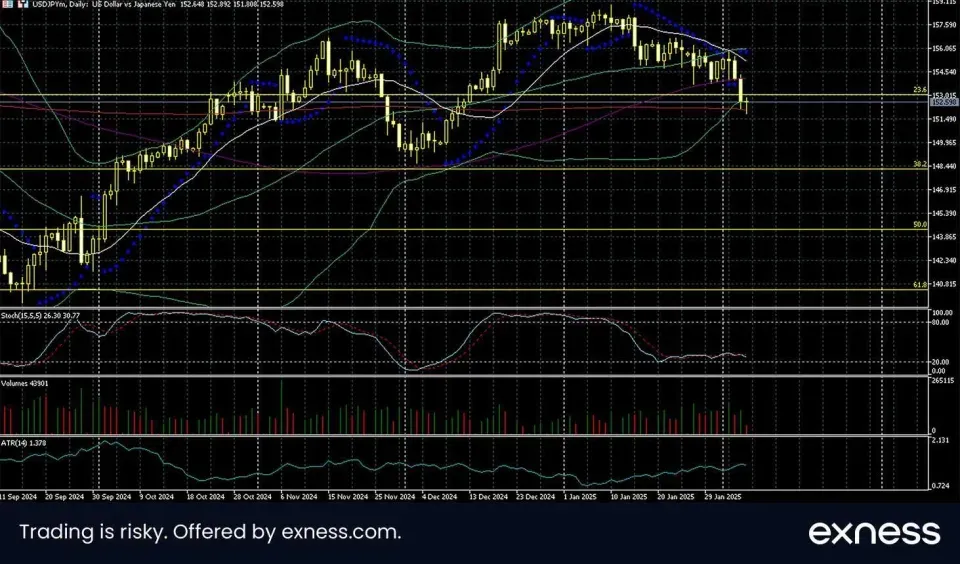
The USD/JPY pair saw considerable pressure downwards, reaching a two-month low on February 6. This was after BoJ officials mentioned that Japan's inflation might continue to stay at lofty levels. Data also revealed that average earnings in Japan have been rising steadily, which supports tightening monetary policy.
Despite this, the next BoJ policy meeting is over a month away, which makes immediate rate hikes uncertain. Another factor worth noting is Japan's relative insulation from American tariffs, which would mean that external trade factors are unlikely to be a major influence on the near-term performance of the yen.
According to technical analysis, the dollar-yen pair breaks its support at the 23.6% weekly Fibonacci retracement near ¥153. Signs of overbought conditions are also appearing, with ¥150 being the most crucial downside target. There is also a probability of a rebound at ¥154 near the 100-day Simple Moving Average. Politically, as the yen is considered safer now compared to the dollar, the political developments could easily shift this balance very quickly.
US Job Market Outlook and the Federal Reserve's Next Move
The last two NFP reports were exceptionally strong, leaving one with a highly optimistic outlook for the US job market. However, expectations for the release on Friday suggest a fairly modest slowdown, with the likely addition of around 170,000 jobs being created. A flat level of unemployment is expected, in fact 4.1%.
The Federal Reserve's monetary policy stance is the prime target for traders. The chance of an interest rate cut by June currently stands at more than 60% based on the CME FedWatch tool. If the NFP data exceeds expectations, these odds may reduce, and thus strengthen the dollar.
Meanwhile, new American tariffs of 25% on Canada and Mexico, and 10% on China, came into effect last weekend. Europe and the UK have been spared so far, but China has retaliated with measures on some imports. While these were largely expected, their impact on volatility remains as traders watch international responses and supply chain disruptions.
Euro-Dollar's Next Move Hinges on NFP Results
Euro weakness has been triggered by the uncertainty of potential new US tariffs and diverging monetary policies. EU economic data have been rather good lately, but the European Central Bank is not likely to shift its policy position significantly in the near term.
Key technical levels for EUR/USD are that support at $1.02 has indeed held following repeated failed attempts to break lower, but resistance around the 50-day SMA might cap upside potential, especially given the failure of strong buying earlier in the week to drive prices above $1.04.
Historically, major forex pairs tend to make sharp movements after the NFP report. A weak NFP could drive EUR/USD higher, possibly breaking $1.04. Conversely, a strong report may reinforce dollar strength, preventing new lows but keeping the euro under pressure.
Market Sentiment and Future Outlook
Beyond the NFP report, some crucial data awaits for the shape of US expectations of the Feds' move in later decision rates. Expectations are ripe if inflation progresses to its earlier trends. However, the overall effect will naturally spill over forex markets.
For now, traders are focusing on economic indicators, geopolitical events, and central bank signals. While the dollar maintains broad strength, emerging trends in safe-haven assets like the yen and gold indicate that investor sentiment is still cautious.
FAQs
How does the NFP report affect the US dollar?
It tells one about US job growth and the overall economic health of the country. In general, a strong report would favor dollar strength, and any weak report can make the dollar lose some strength.
Why is the Japanese yen going up against the US dollar?
The yen has a safe haven characteristic and usually draws investors' money during periods of uncertainty. Furthermore, it's because people are expecting potential BoJ tightening that's boosting the yen's strength.
How do US tariffs affect the forex?
An increase in tariffs can shift some share of global trade inside the United States, boost economic growth, and affect currency valuations. When tariffs rise, there is often uncertainty that increases demand for safe havens, including gold and the yen.
What are the key levels EUR/USD should watch?
The key support is located at $1.02. There is minor resistance near $1.04, which an actual break above or below would indicate significant moves.
What else do traders need to watch for following the NFP report?
The US inflation data next week will be a very important indicator of Fed policy. Rising inflation can change rate expectations and, hence, currency movement.
The US dollar remains firm as market participants anticipate the February 7 NFP report. While the yen continues to gain traction, the euro struggles amid trade concerns and policy divergences. Traders should closely monitor economic releases and geopolitical developments for further insights into forex market trends.