Meta Reality Labs Losses Reach $17.7 Billion in 2024: What You Need to Know
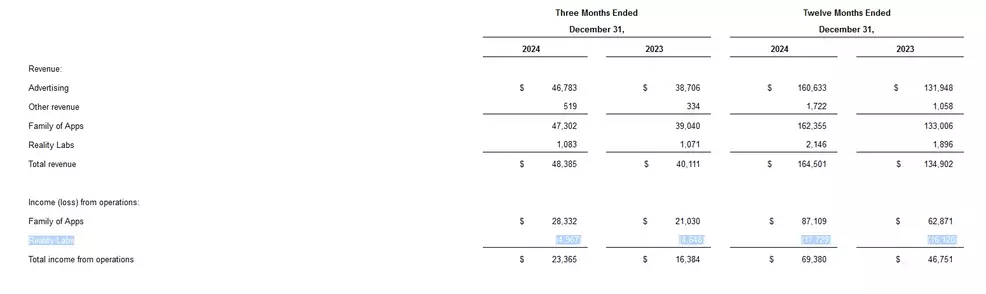
Meta's Reality Labs division reported a massive $17.7 billion loss in 2024, with $4.97 billion of those losses occurring in Q4 alone, continuing a trend of rising expenditures.


The Reality Labs division at Meta certainly faced one tough year for the company's advancements in virtual reality and augmented reality. The most recent quarterly earnings report shows the firm met a rather unwelcoming end with the year's year-end and fourth-quarter report showing heavy losses. Reality Labs took an overall loss of $17.7 billion over the fiscal year 2024, with the bulk of that coming in the fourth quarter at $4.97 billion.
This comes as part of Meta's increased financial woes experienced in Reality Labs, as it has generated continuous losses. During fiscal 2023, Reality Labs posted a loss of $16.2 billion, and a gain of over $1 billion for 2024 indicates an opposite trend for the company. Although the growing losses reflect poor performance, Meta is still posting positive revenue and EPS figures, but heavy financial woes from Reality Labs are a point of focus that cannot go unnoticed.
Its big investments in innovative technologies, also known as metaverse-related items, have weighed down the overall losses. Facebook's CEO and Meta's former president, Mark Zuckerberg, once shared his company's ambition and desire to rebrand itself from being a dominant leader in creating a metaverse. Reality Labs' losses bring into light monetization difficulties through these ambitious initiatives and a protracted road forward for profitability.
Reality Labs and Investing by Meta on Metaverse.
Meta started shifting its focus away from its original social media business and more towards VR and AR technologies a few years ago, when Mark Zuckerberg announced that the future of the internet would involve immersive virtual experiences, and rebranded Facebook as Meta in 2021. Billions of dollars are being poured into Reality Labs by Meta to try to become one of the most dominant players in the Metaverse, an ambitious virtual world which integrates gaming, social interactions, commerce, and much more.
But with the Reality Labs business still hemorrhaging money, the pressure on Meta from investors and analysts mounts over whether such a long-term strategy is sustainable. Meta has made significant investments in virtual reality hardware, such as the Oculus series, and other technologies like AR glasses and software tools designed for both consumers and businesses. It remains in its infancy, and broad adoption is far off, so the financial stress on Reality Labs may continue for several more years before the company realizes a big return on investment.
Despite such hardships, Meta aspires to stick to its vision, where the company has reaffirmed its commitment to a Metaverse by its CEO, Zuckerberg, even when losses continue to soar. The executive team also pointed out that it is ready for continued investment in Reality Labs and asserted that the future of the division will impact Meta's long-term strategy.

Increasing Losses and Meta's Roadmap Ahead
The Reality Labs division of Meta is not the sole one that struggles in the VR and AR business. Really, struggling with monetizing products is common across tech sectors-investing companies into something similar. Though consumer interest keeps growing, virtual reality and augmented reality still have not reached a popularity to leverage mass adoption similar to a smartphone or a social media platform. The cost of hardware development is still highly prohibitive, and the long-term prospect of the Metaverse is still somewhat uncertain.
These issues continue to weigh heavily on Meta, and on many other companies in this space.The losses for 2024 are substantially higher than those placed on the books by Reality Labs. Still, on the whole, Meta's performance has been solid, even glorious in other areas: most markedly in digital advertising, which remains at the heart of the company's revenue model. In the face of these continuing losses, Meta has reaffirmed its commitment to the Metaverse but has also begun looking for ways to balance its investments in Reality Labs with other more profitable areas of the business.
In the near term, the company is likely to continue refining its product offerings in the VR and AR markets, possibly focusing more on practical use cases for businesses and enterprises. Meta's Horizon Worlds platform, one of the Metaverse projects, has been targeting gamers and social VR enthusiasts. However, the interest in VR and AR is growing for more practical applications like virtual meetings, training, and education. Focusing on the expansion of the utility of its VR and AR products, Meta hopes to push the adoption and shift Reality Labs toward profitability.
The Road Ahead for Meta and Reality Labs
Of course, the road ahead is fraught with delicate balancing acts. The company must continue its aggressive push into the Metaverse while managing the financial drain that Reality Labs represents. It also needs to reassure its investors that the long-term payoff from its Metaverse investments will eventually justify these losses. While the near-term picture remains bleak, the investment in the Metaverse by Meta indicates that this company is ready to place bets on a future where immersive virtual environments become part of how people interact with the digital world.
Meta's capacity to get past this challenging time will depend on several factors:. This encompasses the technological improvements in VR and AR, consumer behavior shifts, and the ability of the company to build a sustainable business model for the Metaverse. For now, Meta is doubling down on its Vision for the future, but it will be crucial for the company to manage its losses and look for innovative ways to ensure that Reality Labs can eventually become a profitable segment of its business.
Frequently Asked Questions
What is Reality Labs?
Reality Labs is Meta's division focused on virtual reality (VR), augmented reality (AR), and related technologies. It is responsible for developing products like the Oculus VR headsets, as well as Meta's Metaverse initiatives.
Why did Meta's Reality Labs lose $17.7 billion in 2024?
The main losses in 2024 are due to the continued investment by Meta in the development of VR and AR technologies and the long-term vision for the Metaverse. Though these areas are gaining more attention, monetization is still a challenge.
How does Reality Labs' performance impact Meta's overall business?
Although Reality Labs is still incurring losses, the core business of Meta-which is in digital advertising-is extremely profitable. But investors have concerns with these rising losses, and Meta must balance its investment in the Metaverse with the profitability from the traditional business.
Will Meta be able to recover these losses in the future?
Meta is betting on the long-term success of the Metaverse and believes that immersive VR and AR technologies will eventually see mass adoption. The company is focused on developing practical use cases for these technologies, which could help turn Reality Labs into a profitable division in the future.
What is the Metaverse, and how does it relate to Meta's strategy?
The Metaverse is a virtual space that combines VR, AR, and other digital environments where users can interact socially, play games, conduct business, and more. Meta’s strategy centers around becoming a leader in the Metaverse, and Reality Labs is integral to this vision.
Meta's Reality Labs division continues to face massive financial challenges, with $17.7 billion in losses for 2024. The future of the Metaverse is uncertain, but Meta is committed to this vision, as it believes in the potential of VR and AR technologies. The company's strategy of continued investment is going to put short-term pressure on its financials, but the question will be how effective it can be in monetizing these innovations and dealing with the pains of integration of such ambitious Metaverse goals. Therefore, it will be an interesting journey that Meta will go through over the coming years.