From Congestion to Innovation: The Future of AI-Powered Traffic Solutions

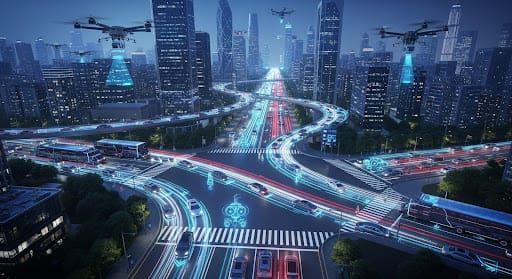
The quick growth of cities and the increased need for better transport have created an urgent demand to develop smarter, more flexible infrastructure solutions. Research shows that by 2050, about 70% of people worldwide will live in urban areas putting huge stress on transport systems and road networks. At one point, traffic jams alone cost the U.S. economy $87 billion each year in lost productivity, while poor transport infrastructure led to more carbon emissions, safety problems, and higher upkeep costs.
Among the most pressing challenges is the process of parsing real-time traffic data and interpreting it to allow urban mobility. Conventional traffic management systems generally rely on models that are outdated for today's world of complex transportation. Moreover, traditional monitoring methods struggle with accuracy and scalability, limiting their ability to support dynamic urban planning. To tackle these issues, we need to rethink our approach. This means bringing together the latest AI, LiDAR tech, and machine learning to create smarter and more efficient ways to handle transportation.
Ravi Jagidar, a seasoned Traffic Engineer is spearheading this transformation. His pioneering work in AI traffic solutions, LiDAR-based monitoring, and predictive modeling for infrastructure search is revolutionizing how cities address transportation challenges. The other side of the coin is that his expertise transcends the technical side; his research and leadership provides inputs in industrial standards and future advancements in smart transportation.
Ravi has created a more affordable LiDAR system to monitor traffic, which has caught the eye of independent researchers and found its way into real transportation projects. Regular traffic sensors often cost a lot and struggle with environmental issues, but his smart solution uses affordable LiDAR sensors to provide real-time accurate data about traffic flow and congestion. This new technology helps cities improve their adaptive traffic signal systems, boosting efficiency and cutting down on traffic jams in busy urban areas.
During his time as a project engineer with Rhythm Engineering, he contributed to the deployment of coordination plans for over 40 intersections. While the company developed the core technology, his involvement in its implementation played a key role in enhancing how cities refine their intersection control strategies. The result was outstanding; more synchronized and effective urban mobility systems.
His researches have a direct impact on how cities refine their intersection control strategies, resulting in more synchronized and effective urban mobility systems. Not only has his work been put into action in real-world projects, but it has also been mentioned in independent research on AI-driven traffic management further proving its industry-wide effect.
Besides being an innovator on the technical front, Ravi has also contributed to shaping thought leadership in the domain of transportation engineering. He has given a guest lecture at the Transportation Research Board Annual Meeting: a prestigious global forum for discussing the future of mobility. His peer-reviewed papers in high-impact journals have been widely referenced, reinforcing his position as a leader in advancing AI-driven transportation solutions. His contributions extend beyond academia, as his methodologies have contributed to supporting government policies and urban planning efforts. These efforts were aimed at transitioning towns toward a smarter and more adaptable traffic management system.
His innovations’ impact can be tracked and measured through the outcomes arising out of his work. A study claims cities that implemented AI-driven traffic optimization strategies have reported congestion reduction amounts of up to 25% whereas maintenance predictive models driven by machine learning have drastically reduced repair costs of the infrastructure. LiDAR-based monitoring is now attracting traffic data collection in real-time, influencing more real-time and efficient decision-making for urban transport network considerations. His research on metaheuristic-based machine learning approaches developed predictive analytics for transportation infrastructure, thus inducing cost efficiency and operational effectiveness.
His work on intersection-based data for turning movements and two-channel LiDAR sensors has set new industry standards. These standards provide traffic engineers with accurate real-time data for optimizing road use.
What if these solutions were never implemented? Inaction could have many effects. Cities would face traffic congestion and increased fuel consumption due to underutilized traffic signals. These issues would be exacerbated by the lack of contemporary traffic prediction models. Real-time LiDAR traffic monitoring would be crucial for traffic controllers and engineers. Without it, their awareness of traffic congestion patterns would be limited, hindering data-driven decision-making in urban mobility. The transport sector would also lag in the adoption of AI-driven transportation policies without thought leaders like Ravi, delaying critical progress toward advanced modern infrastructure planning.
Ravi is even influencing research on construction materials. His metaheuristic machine learning approaches are used to predict concrete compressive strength. This helps improve the efficiency and effectiveness of quality control in civil engineering projects. His research focuses on increasing the durability of construction materials. This research also promotes sustainability in infrastructure, leading to lower maintenance costs in the future.
Recognizing the convergence of engineering innovation and sustainability, Ravi's efforts coincide with the global attempt to develop resilient infrastructure. This endeavor will be capable of meeting the challenges of the future. Ravi has guided an entire team of engineers, worked collaboratively with multidisciplinary teams, and brought an ardent flame for experimentation testing to ensure the effective integration of artificial intelligence with real-world engineering practice.
With an optimistic outlook on the future of smart infrastructure, Ravi Jagidar expresses, “The integration of AI, LiDAR, and machine learning in transportation is not just about efficiency'; it’s about creating sustainable, safer, and more adaptive urban environments. The future of mobility depends on our ability to innovate and embrace data-driven solutions that transform how we design and manage our infrastructure.”
As cities from all over the world grapple with the simultaneous challenges of urbanization. Ravi’s efforts demonstrate how engineering innovation and thought leadership have begun to stimulate a better future, one that is smarter and more sustainable. AI-based traffic solutions, predictive analytics, and intelligent urban planning are core areas of pioneering activity. These technologies are re-inventing modern infrastructure by setting new benchmarks for efficiency, safety, and long-term resilience in transportation. His current research and contributions thus promise a better future of transportation. A future that is not only smarter but also more sustainable and inclusive for the benefit of industry and the larger society.