EU Commits to 200 Billion Euros in AI Investments
The European Union is reinforcing its AI ambitions with a 50-billion-euro investment boost, positioning itself as a global leader in trustworthy AI while countering competition from China and the U.S.

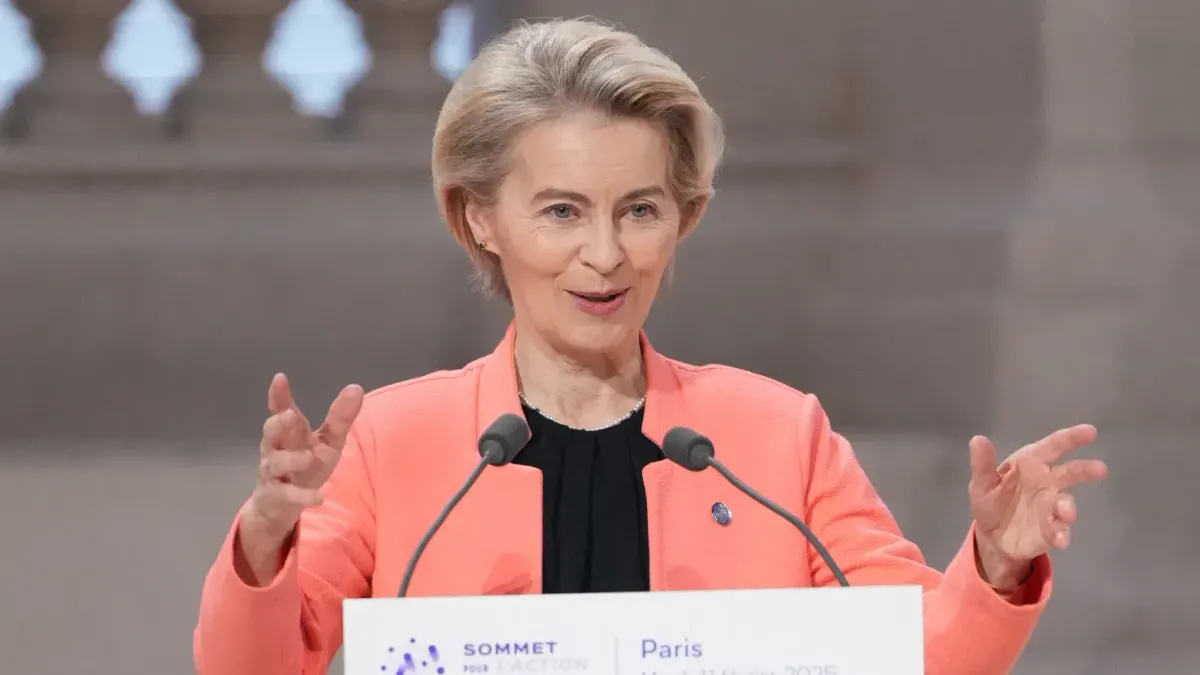
On Tuesday, European Commission President Ursula von der Leyen announced the European Union's decision to mobilize a total of 200 billion euros, equivalent to about $206.5 billion, in investments on artificial intelligence. It is for this reason that this initiative hopes to cement the status of Europe as a primary stakeholder in the AI market.
Funding has been promised through a previously announced 150-billion-euro commitment from investors and industry. The EU has topped this amount by adding an extra 50 billion euros. Addressing the AI Action Summit in Paris, Von der Leyen described it as "the largest public-private partnership in the world for the development of trustworthy AI."
Strategic Vision on AI Development
The EU's strategy on AI involves industrial applications, as well as the creation of European "gigafactories" for large AI models' processing. As she pointed out, Europe should focus on producing AI solutions applied to industry-specific needs, thus taking advantage of the continent's rich industrial manufacturing data and its scientific expertise.
She emphasized that the approach of Europe to AI would be safety first, trustworthy, and widespread acceptance across all industries. This step is in accordance with the ethical AI commitment by the EU towards technology that should serve society but maintain data security and privacy.
Europe's Stand in the Race of AI
Vouching for concerns that Europe has fallen behind on AI, Von der Leyen strongly refuted the notion that China and the United States had already secured a leadership position. "Too often I hear that Europe is late to the race — that China or the United States have already gotten ahead. I disagree, because the AI race is far from being over," she declared.
She further argued that AI leadership is dynamic and constantly evolving. The EU aims to excel in the adoption of AI in complex industrial settings, ensuring that European companies have access to supercomputing power and AI infrastructure necessary for growth.
Collaborative AI Ecosystem and Global Implications
One of the EU's main objectives is an AI ecosystem somewhat like that being developed at the famous particle physics laboratory, CERN. Speaking on the value of cross-border collaboration and building talent across Europe and industry borders, Von der Leyen promised to "build a machine in which every element is worth billions.".
Besides technological competitiveness, the EU sees AI as improving economic productivity, security, healthcare, and access to information. However, the rapid development of AI has generated a lot of controversies on its high energy consumption, especially deepfake-generation-related disinformation.
International Competition in AI and Strategic Investment
The EU’s AI investment announcement comes amid significant AI developments worldwide. French President Emmanuel Macron recently disclosed that France’s AI sector will receive 109 billion euros ($112.6 billion) in private investment. Macron compared this commitment to the United States’ massive 500-billion-dollar AI investment initiative, known as “Stargate,” spearheaded by former U.S. President Donald Trump.
Additionally, U.S. Vice President JD Vance emphasized that the United States remains committed to countering authoritarian regimes’ misuse of AI. He warned about AI’s potential role in enhancing military intelligence, surveillance, and propaganda efforts.
Challenges and Ethical Considerations
Despite the excitement surrounding AI advancements, critics highlight potential challenges, including:
Energy Consumption: AI requires significant computational power, leading to concerns over its environmental impact.
Deepfake Threats: Manipulated AI-generated content could contribute to misinformation and political manipulation.
Regulatory Balance: Ensuring AI safety while fostering innovation remains a delicate challenge for policymakers.
The EU's AI investment strategy aims to address these concerns by promoting ethical AI standards, fostering innovation, and ensuring AI serves humanity's best interests.
FAQs
Why is the EU investing 200 billion euros in AI?
It aspires to make the EU the first choice in AI development: trustworthy and industrial applications. Its investment will facilitate research, provide supercomputing power, and enhance AI use across industries.
EU's AI Funding in Comparison to Other Global Programs
The AI funding of the EU is parallel to the funds of China and the U.S. France announced 109 billion euros, whereas the U.S. has stated its 500-billion-dollar AI plan under "Stargate".
What does the EU's AI investment mean to achieve?
The EU aims at developing an application of AI for industries, developing ethical AI, and boosting economic productivity, security, and medical health services.
What is a big concern facing AI development?
Concerns are high energy consumption by AI machines, its misuse in creating deepfake-generated misinformation, and the hassles in the regulatory balance while trying to be innovative.
How will the EU advance responsible AI development?
Ethical AI practice, as the EU commits, ensuring AI technologies safely, transparently, and privately transform while fostering a collaborative AI ecosystem.