Doomsday Clock Set to 85 Seconds to Midnight — Humanity Closer to Catastrophe Than Ever

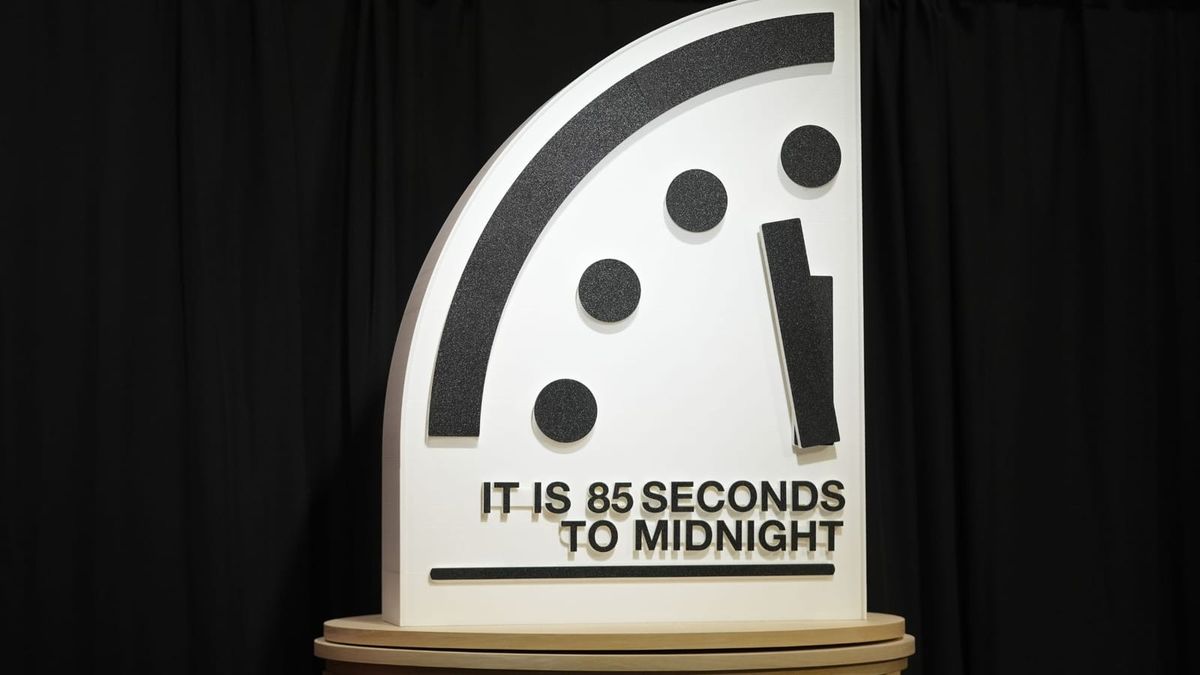
On January 27, 2026, the Bulletin of the Atomic Scientists announced that its symbolic Doomsday Clock — a widely watched indicator of humanity’s risk of self-inflicted disaster — has been moved to 85 seconds to midnight, marking the closest it has ever been to symbolic annihilation since the clock was created in 1947. Midnight on the Doomsday Clock represents a theoretical point of global catastrophe caused by human actions.
Scientists said the change reflects a dangerous mix of persistent and emerging threats, including geopolitical tensions, nuclear instability, climate change, the rapid advance of artificial intelligence (AI) and other disruptive technologies, and declining international cooperation. They used this year’s annual announcement to warn that the world faces growing risks that require urgent global action to reverse.
The Symbolism of 85 Seconds to Midnight
The Doomsday Clock was first introduced in 1947 by scientists who helped develop the atomic bomb — including figures associated with the Manhattan Project — as a metaphor to communicate the existential threats posed by nuclear weapons. Over the decades, its position has been updated annually based on global political, environmental, technological, and security developments.
For much of its history, the clock measured minutes to midnight. In recent years, experts began counting in seconds to more precisely signal increased risk levels. Prior to this year’s update, it stood at 89 seconds to midnight, already its closest showing. Moving the clock to 85 seconds underscores what experts describe as deteriorating global stability.
Why Scientists Moved the Clock
In announcing the 2026 setting, the Bulletin’s Science and Security Board highlighted several major factors driving the shift:
- Nuclear instability and geopolitical tensions among major powers, including ongoing conflicts and the fraying of international arms-control agreements.
- Climate change, with insufficient global action to curb emissions and escalating environmental impacts.
- Disruptive technologies, especially artificial intelligence and biotechnology, whose rapid development outpaces regulatory frameworks and safeguards.
- Weakening international cooperation and rising nationalism that, scientists argue, undermines efforts to address existential threats through diplomacy and collective action.
In their statement, Bulletin leaders said that rather than reducing these risks, global trends over the past year have intensified them, while diplomatic frameworks designed to constrain dangerous competition have weakened. They stressed that the clock’s new position reflects a failure of leadership on issues central to human survival.
Nuclear Tensions and Treaty Concerns
Nuclear weapons remain a central concern for the Bulletin’s assessment. Experts cited the looming expiration and weakening enforcement of arms-control treaties, as well as rising tensions among countries that possess nuclear arsenals. Such political volatility, the scientists warn, increases the chance of miscalculation or escalation into broader conflict.
The board also flagged destabilizing conflicts and regional hostilities — involving nations like Russia, China, India, Pakistan and others — which contribute to a global security environment where the risk of nuclear weapons use, intentional or otherwise, is heightened.
Climate Change and Emerging Technologies
Although nuclear risk anchored the clock’s original purpose, today’s assessment incorporates other long-term dangers. The climate crisis, including record temperatures, rising emissions, and ecological disruption, now plays a pivotal role in the clock’s calculation. Scientists argue that continued failure to meet global climate goals deepens systemic risks that threaten life and stability worldwide.
Simultaneously, rapid advancements in artificial intelligence and biotechnology have introduced new layers of uncertainty. Without robust international norms and safety measures, these technologies could amplify disinformation, hasten the development of biological threats, or even affect decision-making in military and security systems.
A Call to Action
While the Doomsday Clock’s update is symbolic and not a scientific prediction, scientists say its purpose is to draw public attention to severe, interconnected global risks and to encourage proactive leadership. Officials from the Bulletin emphasize that the clock can be “turned back” if governments, institutions and civil society make substantive progress on disarmament, climate mitigation and technology governance.
Leaders like Alexandra Bell, president and CEO of the Bulletin, have underscored that the world still has opportunities to avert catastrophe — but that time is running short. Their message urges global cooperation and meaningful policy action to reduce the threats reflected in the clock’s setting.
Historical Context
The Doomsday Clock has never been closer to midnight since its inception in the aftermath of World War II. At its furthest point from catastrophe — 17 minutes to midnight in 1991 — the world was emerging from the Cold War with deep cuts to nuclear arsenals. In contrast, today’s closer setting reflects a complex risk landscape that spans nuclear weapons, climate breakdown, technological disruption and political fragmentation.
The watch remains a stark reminder that human actions profoundly shape global safety and that collective solutions are vital to prevent the worst potential outcomes.