Diff’rent Strokes Actress Melanie Watson Dies at 57

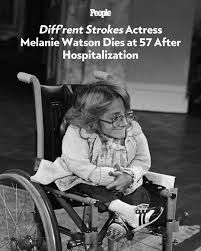
Melanie Watson Bernhardt, the actress whose brief but memorable role on the beloved 1980s sitcom Diff’rent Strokes helped shape on-screen representation of disability, died at the age of 57 on December 26, 2025, in Colorado Springs, Colorado, her family confirmed. Her passing followed a recent hospitalization during which she faced serious bleeding issues, and despite medical efforts, her condition quickly deteriorated. Her brother, Robert Watson, told media outlets that though the family is grieving, they are grateful for the years she had despite her lifelong health struggles.
Born with osteogenesis imperfecta, a rare genetic disorder often referred to as brittle bone disease, Watson lived with a condition that caused her bones to fracture easily and shaped both her personal life and the roles she pursued. The disorder also affected her mobility, leading her to use a wheelchair for much of her life. On Diff’rent Strokes, Watson brought her own experience to the role of Kathy Gordon, a friend of Gary Coleman’s character Arnold Jackson, whose presence in four episodes helped audiences see a character with a disability as part of everyday life on television.
Watson first appeared on Diff’rent Strokes in the early 1980s, a time when few television shows included disabled characters in recurring roles. Her episodes, including the 1982 installment named after her character, explored themes of independence and friendship with sensitivity. In one memorable storyline, Arnold encourages Kathy to attempt walking without crutches, a moment that highlighted both her determination and the challenges she faced, and that resonated with viewers for its emotional honesty.
Despite the physical difficulties she navigated, Watson’s contribution to the show stood out for its authenticity. In later interviews, she reflected on her time on set, recalling how accessibility barriers — like being carried when her wheelchair couldn’t easily move around production equipment — were a constant challenge. But she also spoke with pride about how Diff’rent Strokes opened doors for disabled performers and audiences alike, and credited producer Norman Lear for including characters that challenged norms at a time when such representation was rare.
After her television appearances, Watson stepped away from acting but remained deeply engaged in advocacy and service. She co-founded Train Rite, an organization focused on training shelter dogs to become service animals for people with disabilities, channeling her own experiences into work that aimed to improve lives and promote independence. Watson also briefly pursued political engagement, at one point seeking a seat in the Colorado State Senate, though health issues later prevented her from continuing that effort.
Watson’s personal life included a marriage to Roger Bernhardt in the mid-1990s, and though it ended in divorce, she continued to build a life rooted in community engagement and visibility for people facing similar challenges. Throughout her life, she often spoke about the importance of visibility and inclusion, viewing her public platform as an opportunity to change perceptions and encourage empathy.
Her death has sparked an outpouring of remembrance from fans of Diff’rent Strokes and advocates for disability rights, who recall her not just as a guest star on a classic show but as someone who brought depth and nuance to a character that many viewers saw as a reflection of their own experiences. Diff’rent Strokes, which aired from 1978 to 1986 and became known for its mix of humor and heart, welcomed diverse characters into its stories, and Watson’s role remains a meaningful part of that legacy.
Colleagues, viewers, and disability advocates alike have noted that Watson’s presence on television helped broaden the landscape of representation at a time when it was sorely needed. Her life and work serve as a reminder of the impact television can have when it reflects a wider range of human experience. Though her screen time was limited compared with some of her co-stars, the resonance of her performances and her subsequent advocacy work helped ensure she would be remembered beyond the episodes in which she appeared.
As tributes continue to come in, many have highlighted the courage and resilience that defined her life. Watson’s journey — from child actress breaking barriers in Hollywood to founder of an organization dedicated to empowerment — stands as a testament to her strength and commitment to service. In celebrating her legacy, fans honor both her contributions to entertainment and her tireless advocacy for greater inclusion and understanding in society.
Melanie Watson Bernhardt is survived by her brother, Robert, and a legacy of work that reached beyond the screen to touch the lives of many who saw in her not just an entertainer, but an advocate and a trailblazer for representation.