Bronx Rapper Kay Flock Sentenced to 30 Years After Violent Racketeering Convictions

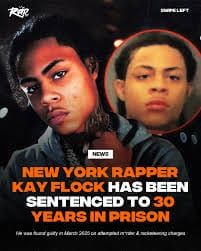
Kevin Perez, the Bronx drill rapper widely known by his stage name Kay Flock, has been sentenced to 30 years in federal prison following a high-profile conviction for his role in a string of shootings and gang-related crimes that shook parts of New York City. The sentence, delivered on December 16, 2025, marks a dramatic end to a rising music career and underscores the federal government’s aggressive approach to prosecuting violent gang activity tied to the drill rap scene.
At just 22 years old, Perez stood before U.S. District Judge Lewis J. Liman in Manhattan federal court, where the judge imposed the three-decade term after a jury convicted him earlier this year on multiple charges. Those included racketeering conspiracy, attempted murder, assault with a deadly weapon in aid of racketeering, and related firearm charges — all linked to Perez’s leadership in the Bronx-based gang known as Sev Side/DOA, prosecutors said.
Judge Liman’s remarks during sentencing made clear that he viewed Perez not simply as a musician but as a central figure in a cycle of violence that spilled onto Bronx streets between 2020 and 2021. The judge criticized Perez for celebrating violence and helping drive retaliation between rival factions, ultimately inflicting serious harm on both gang members and innocent bystanders. “You taunted, you celebrated, and you helped create a cycle of violence,” Liman said in court, stressing that a lengthy prison term was needed to address the severity of the crimes.
The Fall of a Rising Drill Rap Star
Before his arrest in 2021, Kay Flock was emerging as a notable figure in the New York drill scene, a subgenre of hip-hop known for its gritty realism and often violent lyrical content. His 2021 debut mixtape, The D.O.A. Tape, and singles like “Being Honest” earned him attention both locally and nationally and even recognition from Billboard as an R&B/Hip-Hop “Rookie of the Month.”
However, Perez’s musical ascent coincided with escalating violence in his neighborhood, where law enforcement and prosecutors argued he used his platform to glorify shootings and territorial disputes. According to the U.S. Attorney for the Southern District of New York, Jay Clayton, Perez leveraged both his status as an artist and gang leadership role to fuel fear and intimidation, directing and celebrating acts of violence that left numerous people shot or injured.
Federal prosecutors had initially sought a 50-year sentence, reflecting the scope of the violence and the prosecution’s argument that Perez used his fame to bolster gang activity and retaliatory crackdowns. They also highlighted social media posts and private messages in which Perez appeared to taunt rivals and minimize the suffering of victims. Despite those calls, Judge Liman ultimately chose a mid-range punishment that still ensures Perez will spend the vast majority of his adult life behind bars.
Courtroom Battle and Legal Arguments
During the sentencing phase, Perez’s defense team urged the judge to consider his youth and background as mitigating factors, even suggesting he should receive a much lighter sentence. Attorneys argued that he grew up in a community plagued by violence and had been influenced by older gang members. They also contended that Perez’s alleged intellectual disability should weigh in favor of leniency, claiming he was not capable of leading a gang at the level alleged by prosecutors.
Judge Liman rejected those arguments, noting that criminal responsibility for orchestrating violence — even without personally pulling the trigger — deserved a significant sentence. He acknowledged that Perez’s environment and youth might have shaped his early decisions but emphasized that the harm caused by the shootings and Perez’s lack of remorse made a lengthy prison term appropriate.
Perez himself addressed the court, telling the judge that he had changed since his teenage years and asking for a second chance. “What I was at 18 is not what I am today,” he said, maintaining that he had matured since his arrest and expressing belief that everyone deserves an opportunity to reform. But the judge pointed to a lack of genuine concern for the victims as a key reason for upholding a tough sentence.
Broader Impacts on Drill Rap and Community Violence
Kay Flock’s sentencing has sparked discussion across both hip-hop circles and communities affected by gang violence. Some fans and commentators argue that artists should not be held liable for their lyrics or persona, while others assert that Perez’s real-world actions, combined with his artistic platform, contributed to a culture of aggression and retaliation.
In legal circles, the case is also part of an ongoing debate about how prosecutors use elements of rap culture — including music videos, lyrics, and social media activity — as evidence of intent and criminal conduct. Critics contend that such practices can blur artistic expression with actual criminal planning, while proponents argue that when contextualized properly, they help establish motive and involvement in violent enterprises.
Whatever the wider implications, Perez’s 30-year prison sentence effectively ends the momentum of a promising music career and serves as a powerful signal from federal authorities about consequences for those who blend criminal conduct with public influence.
Looking Ahead
In addition to his decades-long imprisonment, Perez was also ordered to serve five years of supervised release following his sentence, a standard provision aimed at monitoring behavior after incarceration. Prosecutors applauded the outcome, saying it reflects justice for victims and a commitment to reducing gang-related violence in New York.
For supporters of tougher crime enforcement, the sentence is a victory in the effort to curb gun violence and gang influence in urban areas. For fans of the rapper and observers of hip-hop culture, it is a stark reminder of the risks that arise when artistic ambition intersects with real-world criminal activity. Regardless of perspective, Kay Flock’s case will remain a focal point in conversations about music, violence and accountability for years to come.